

Last reviewed 7 September 2026. Every figure on this page was checked against the source named next to it; where two official series disagree, the difference is stated.
Online channels now handle the majority of the world's travel spending, and the clearest way to measure that is through the companies doing the booking. Phocuswright puts global travel gross bookings at roughly $1.67 trillion in 2025, of which about $1.07 trillion was booked online. Booking Holdings alone sold 1.24 billion room nights and processed $186.1bn of gross bookings over the year, while UN Tourism counted 1.52 billion international tourist arrivals worldwide. The figures below are drawn from company results filed with the US Securities and Exchange Commission, investor releases, UN Tourism's World Tourism Barometer and named industry research, and are the latest available as of 2026.
Key online travel booking statistics
- Global travel gross bookings reached approximately $1.67 trillion in 2025, with online bookings up 8% to about $1.07 trillion (Phocuswright, Travel Forward 2026).
- Nearly 65% of global travel gross bookings are expected to be made online by 2026, with online travel agencies accounting for roughly $408bn of gross bookings (Phocuswright).
- Booking Holdings sold 1,235 million room nights in 2025, up 8% year on year, on gross bookings of $186.1bn and revenue of $26.9bn.
- Expedia Group booked 415.4 million room nights in 2025, up 8%, on gross bookings of $119.6bn.
- Airbnb recorded 533 million nights and seats booked and gross booking value of $91.3bn, up 12% on 2024.
- Growth continued into 2026: in the second quarter, Booking Holdings' room nights rose 5% to 325 million and gross bookings 9% to $51.0bn, Expedia's room nights rose 6% and Airbnb's nights and seats booked grew 10% (Q2 2026 results, August 2026).
- A mid-fifties percentage of Booking.com room nights were booked through its mobile apps in 2025, up from a low-fifties percentage in 2024.
- Online travel agencies supplied 63.4% of bookings at independent hotels in 2025, against 36.6% booked direct (Cloudbeds, 90 million bookings across 180 countries).
How big is the online travel market?
- Phocuswright's Travel Forward 2026 analysis (published December 2025) puts global travel gross bookings at approximately $1.67 trillion for 2025, with online bookings rising 8% to about $1.07 trillion and forecast to reach $1.2 trillion in 2026.
- Online channels are forecast to account for nearly 65% of all global travel gross bookings by 2026. An earlier Phocuswright forecast put online hotel bookings specifically at 55% of the hotel market in 2024, rising to 58% by 2026.
- Online travel agencies generate roughly $408bn of gross bookings, with Asia-Pacific alone accounting for more than a third of global OTA sales. In India, OTAs account for more than half of all online travel bookings (Phocuswright).
- The underlying demand picture is strong: UN Tourism recorded 1.52 billion international tourist arrivals in 2025, up 4% and almost 60 million more than in 2024, with international tourism receipts of an estimated $1.9 trillion.
- Growth slowed in early 2026: international arrivals rose 2% to around 307 million in the first quarter, and UN Tourism expects the Middle East conflict to trim full-year growth by one to two points below its initial 3–4% forecast (World Tourism Barometer, May 2026).
- Global occupancy in accommodation establishments reached 66% in November 2025, matching November 2024, while international air capacity and air passenger traffic both grew 7% through October 2025 (STR and IATA data, cited by UN Tourism).
Booking Holdings: the world's largest online travel platform
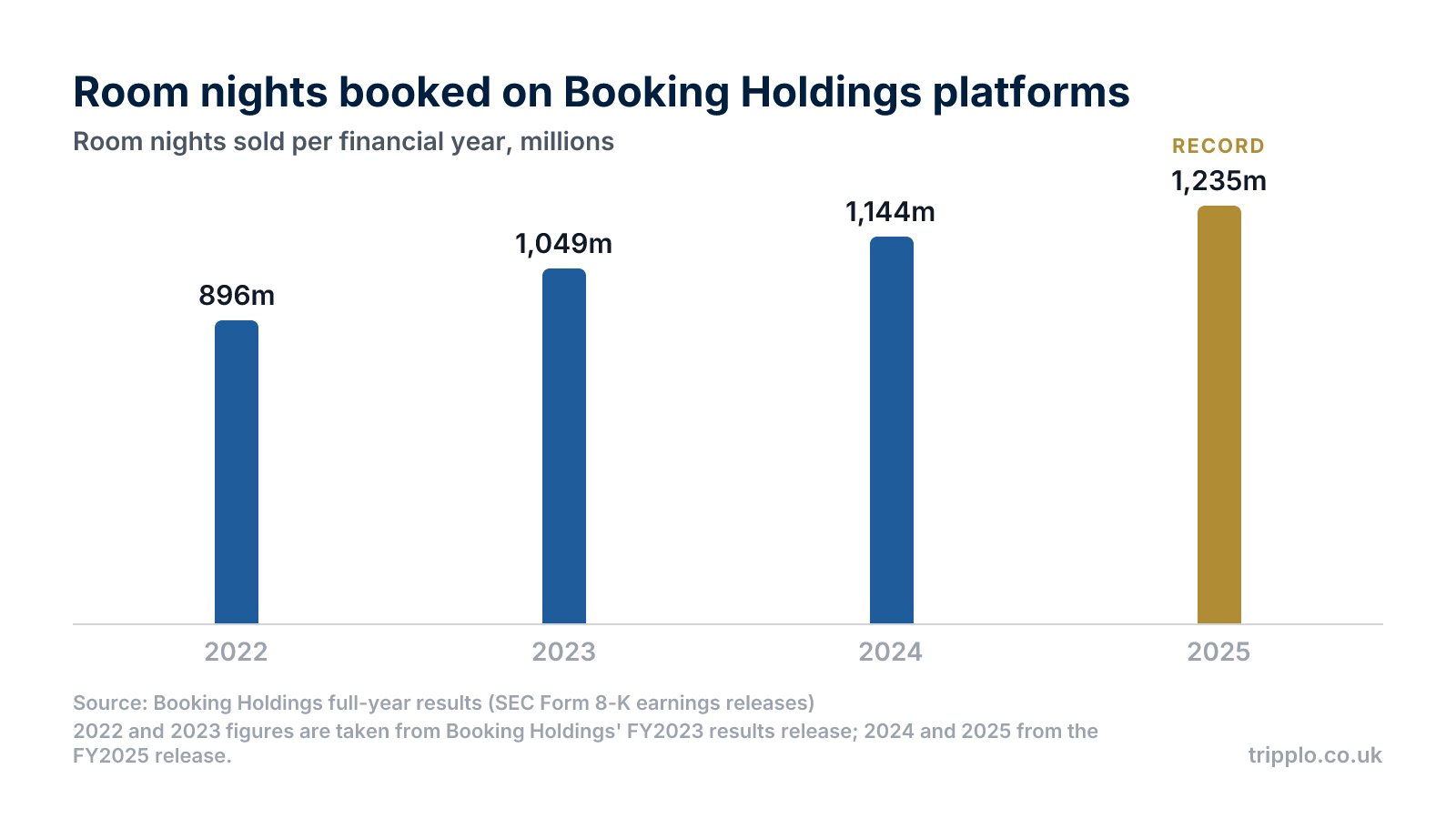
- Booking Holdings sold 1,235 million room nights in 2025, an 8% increase on 2024 and up from 896 million in 2022, according to its fourth quarter and full year 2025 earnings release.
- Gross bookings rose 12% to $186.1bn and revenue rose 13% to $26.9bn, with net income of $5.4bn and a net income margin of 20.1%.
- Merchant gross bookings, where the company takes payment itself, grew 24.8% to $130.0bn in 2025; the older agency model, however, declined 8.7% to $56.1bn — a structural shift in how OTAs transact.
- Booking.com listed approximately 4.4 million properties at 31 December 2025, up from about 4.0 million a year earlier, comprising roughly 3.9 million alternative accommodation listings and about 500,000 hotels, motels and resorts.
- Alternative accommodation accounted for about 36% of Booking.com room nights in 2025, up from approximately 35% in 2024.
- In the second quarter of 2026 room nights grew 5% to 325 million, gross bookings rose 9% to $51.0bn and revenue rose 8% to $7.4bn, with a net income margin of 26.5%, according to the second quarter 2026 earnings release (4 August 2026).
Booking Holdings, Expedia and Airbnb compared
- On 2025 full-year results, Booking Holdings led on gross bookings at $186.1bn, ahead of Expedia Group at $119.6bn and Airbnb's gross booking value of $91.3bn. Each figure comes from that company's own annual results; Airbnb reports gross booking value on a slightly different basis.
- Expedia Group booked 415.4 million room nights in 2025, up 8% from 383.9 million, with revenue of $14.7bn and adjusted EBITDA up 19% to $3.5bn.
- Expedia's growth is increasingly wholesale rather than consumer-facing: B2B gross bookings grew 24% in the fourth quarter of 2025 against 5% for B2C.
- Airbnb recorded 533 million nights and seats booked in 2025, up 8% from 492 million, with revenue of $12.2bn, according to its annual report on Form 10-K.
- Trip.com Group, the largest Asian player, reported full-year 2025 net revenue of RMB62.4bn (US$8.9bn), up 17%, with accommodation reservation revenue up 21% to RMB26.1bn.
- Second-quarter 2026 results show the challengers growing faster: Expedia Group grew gross bookings 12% to $33.9bn on 111.5 million room nights (+6%), with B2B gross bookings up 21%, while Airbnb grew gross booking value 16% to $27.2bn and nights and seats booked 10% (August 2026).
- The premium end of the market is growing faster than the average, a pattern also visible in our luxury travel statistics and in demand from independent bookers covered in our solo travel statistics.
Flights and cars: online booking beyond hotels
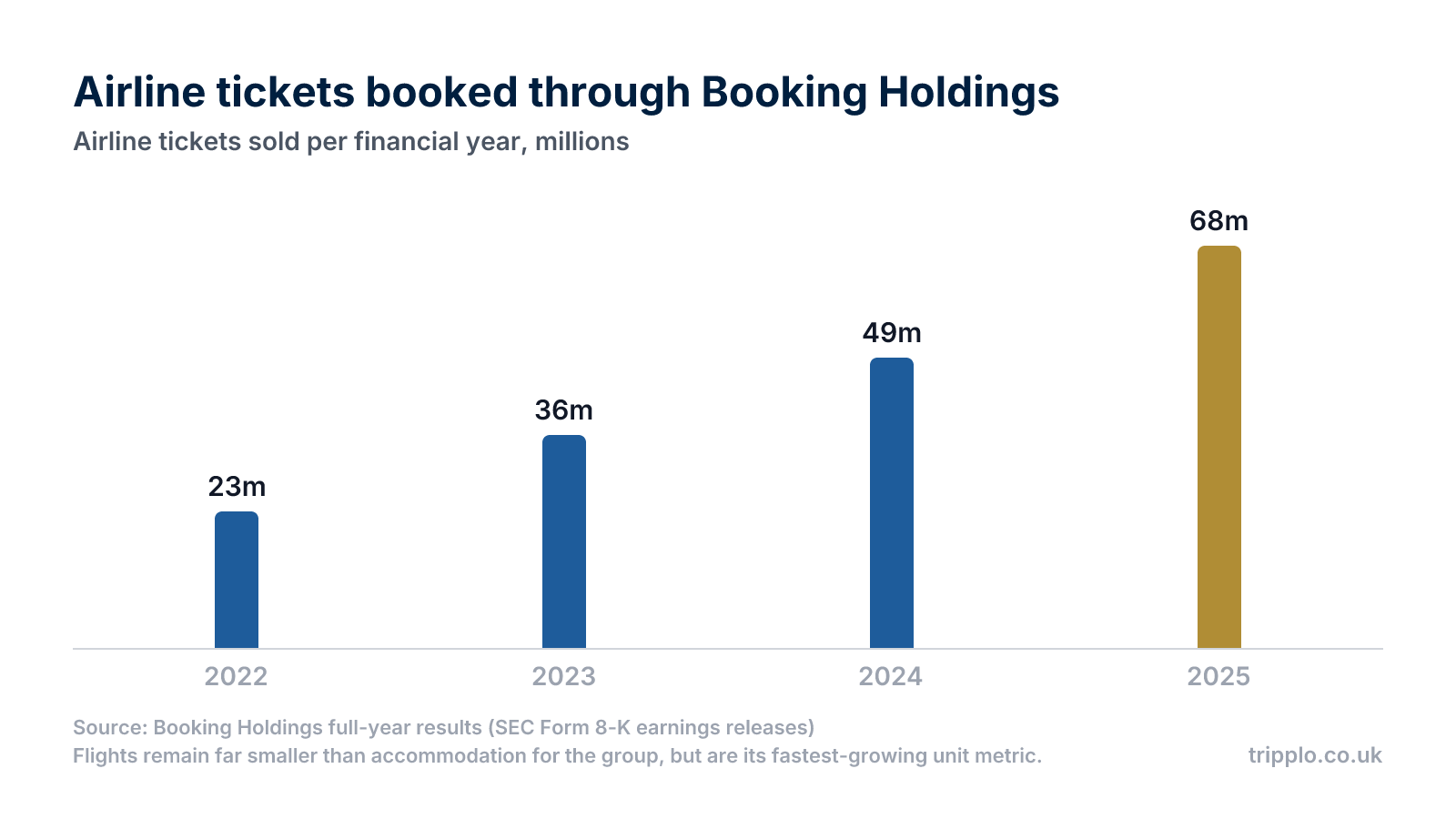
- Booking Holdings sold 68 million airline tickets in 2025, up 36.6% year on year and almost three times the 23 million sold in 2022.
- Rental car days reached 88 million in 2025, up 5.8% on 2024 and up from 62 million in 2022 — solid growth, but far slower than flights.
- Flights are now the group's fastest-growing unit metric by some distance, reflecting a deliberate push to capture the whole trip rather than the hotel stay alone.
- Air capacity supports that shift: international air capacity and passenger traffic each grew 7% in the first ten months of 2025 (IATA data cited by UN Tourism).
Mobile apps and direct booking
- The share of Booking.com room nights booked through its mobile apps was a mid-fifties percentage in 2025, up from a low-fifties percentage in 2024, according to the company's 2025 Form 10-K.
- Booking Holdings notes that the significant majority of room nights booked in its apps come through the direct channel, with favourable repeat booking behaviour from app users.
- Across the trailing four quarters to December 2025, a mid-fifties percentage of Booking Holdings' total room nights were booked through its direct channel, up year on year.
- That direct mix comes at a cost: marketing expense equalled 4.5% of gross bookings in the fourth quarter of 2025, up from 4.2% a year earlier, as the group invested in brand marketing and the US market.
OTAs versus direct hotel bookings
- Online travel agencies supplied 63.4% of bookings at independent hotels in 2025, with some markets approaching 80%, according to Cloudbeds' 2026 State of Independent Hotels Report, based on 90 million bookings across 180 countries.
- OTA bookings cancel far more often: the OTA cancellation rate was 21.8%, more than double the 10.6% rate for direct bookings.
- Independent hotel economics tightened in 2025, with global RevPAR down 5.4%, average daily rate down 5.8% and occupancy down 0.6 percentage points. EMEA was an outlier, with RevPAR up 3.9%, while Asia-Pacific fell 17.5%.
- Travellers booked an average of 40 days ahead in 2025, up from 38 days in 2023, and more than two-thirds of bookings were for one or two nights — though seven-night bookings surged 25% year on year.
- Distribution economics vary sharply by destination; for context on individual markets see our Spain tourism statistics and London tourism statistics.
AI in travel booking
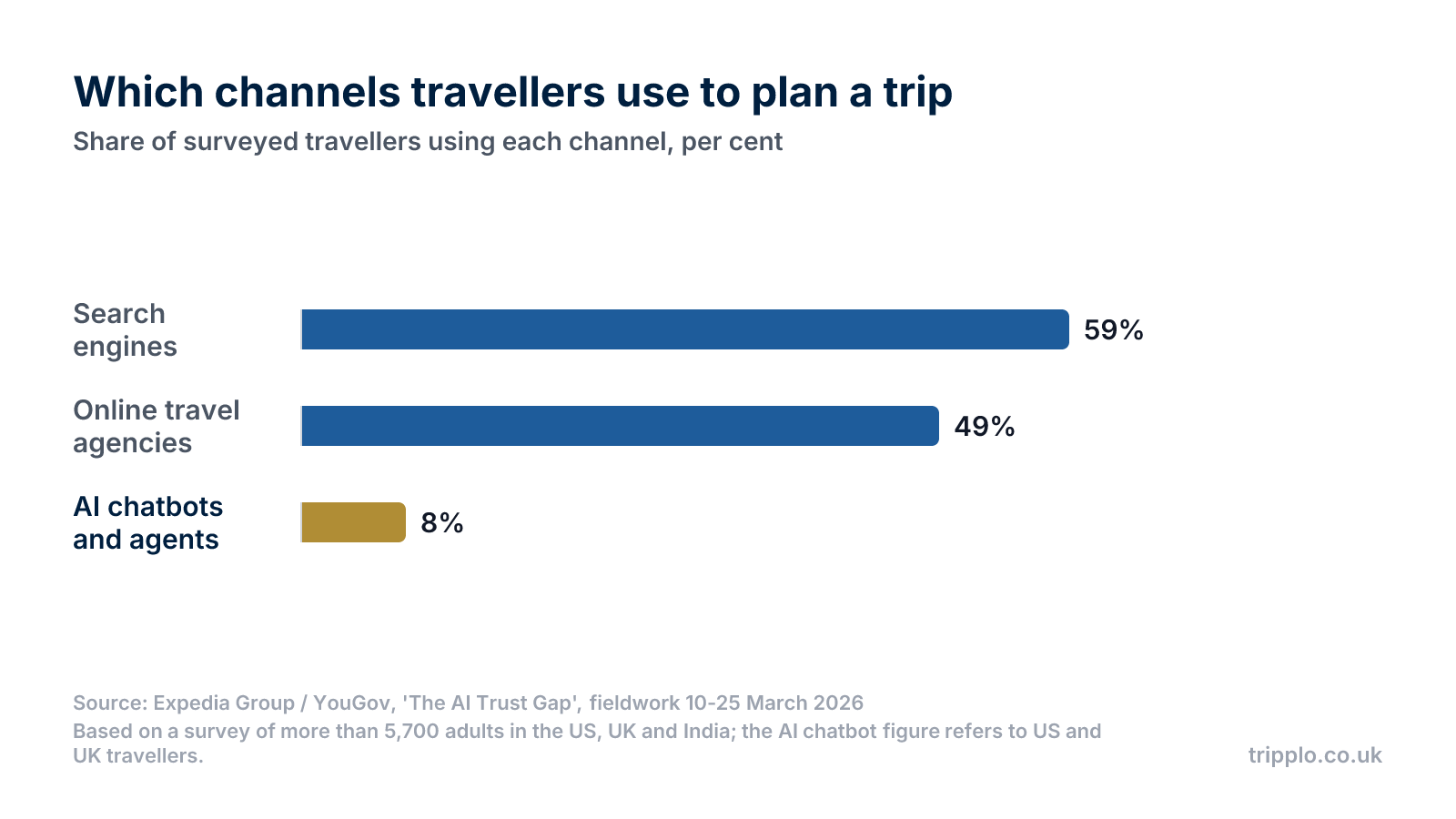
- Only 8% of US and UK travellers rely on AI chatbots or agents such as ChatGPT or Gemini when planning a trip, against 59% who use search engines and 49% who use online travel agencies (Expedia Group / YouGov, more than 5,700 adults in the US, UK and India, March 2026).
- The same research found just 8% feel comfortable booking through an AI platform, while 68% prefer to book with a trusted travel brand over an AI chatbot or agent even when AI booking is available, and 66% would not trust AI to book on their behalf.
- Concerns are concrete rather than abstract: 57% worry about loss of control and 57% about data and payment privacy, with 40% citing poor customer service if something goes wrong.
- Adoption is much higher for inspiration than for transactions. Booking.com's Global AI Sentiment Report, surveying 37,325 people across 33 markets, found 67% had already used AI in some aspect of travel, yet only 6% said they fully trust it and 42% always fact-check its output.
- Phocuswright reports that 58% of active US travellers had used AI for at least one purpose by the second half of 2025, and 39% had used it specifically for travel research or planning, up from 28% a year earlier (Travel Forward 2026).
- Booking Holdings chief executive Glenn Fogel said the group remains focused on advancing its use of generative AI to enhance the value it delivers to travellers and partners, with a transformation programme targeting about $550m of annual run-rate savings by the end of 2026.
Sources
- UN Tourism — International tourist arrivals up 4% in 2025 (World Tourism Barometer, January 2026)
- UN Tourism — International tourism up 2% in Q1 2026 (World Tourism Barometer, May 2026)
- Booking Holdings — Fourth quarter and full year 2025 earnings release (SEC Form 8-K)
- Booking Holdings — Annual Report on Form 10-K for 2025 (SEC)
- Booking Holdings — Full year 2023 earnings release, for 2022 and 2023 unit data (SEC)
- Booking Holdings — Second quarter 2026 earnings release (4 August 2026)
- Expedia Group — Fourth quarter and full year 2025 results
- Expedia Group — Second quarter 2026 results (5 August 2026)
- Airbnb — Annual Report on Form 10-K for 2025 (SEC)
- Airbnb — Q2 2026 financial results (6 August 2026)
- Trip.com Group — Unaudited fourth quarter and full year 2025 results
- Booking.com — Global AI Sentiment Report (July 2025)
- Expedia Group — 'The AI Trust Gap' research with YouGov (April 2026)
- Cloudbeds — 2026 State of Independent Hotels Report
- Phocuswright — Travel Forward: Data, Insights and Trends for 2026 (PhocusWire, December 2025)
- Phocuswright — Global Travel Market Report 2025 forecast (via Hotel News Resource)
Luxury travel, straight to your inbox
Every other week we share destinations and hotels worth the journey, from hidden boutique hideaways to classics that live up to their name.